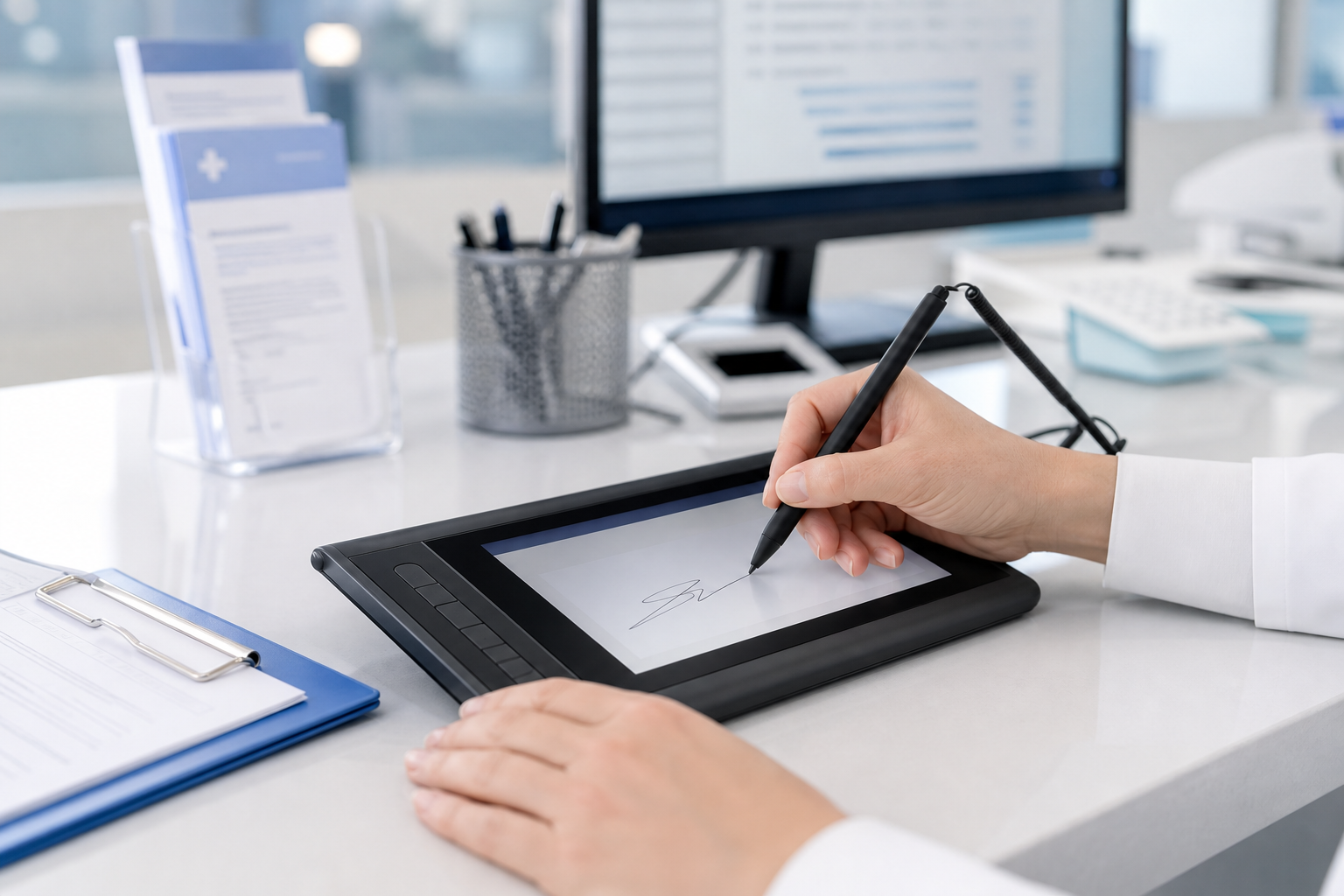
Modern hospitals are under constant pressure to improve patient service while controlling administrative workload. Every day, staff must handle registration, diagnosis, treatment, payment, pharmacy pickup, examination requests and discharge procedures. Many of these processes require patient confirmation or staff approval. If signatures are still collected on paper, the workflow becomes slower and less efficient. This is why more hospitals are using an electronic signature pad to support paperless patient services.
A hospital service process often begins digitally but returns to paper at the signature stage. Staff may prepare a consent form or confirmation document in the computer system, then print it for the patient to sign. After that, the signed paper must be scanned and uploaded again. This creates unnecessary steps and increases the chance of mistakes. The document may be scanned at low quality, uploaded to the wrong file or delayed during busy hours. Electronic signing helps hospitals keep the entire process digital from start to finish.
At the outpatient registration desk, patients can confirm personal information and sign directly on the device. At the laboratory window, patients can sign test consent forms without paper. At the pharmacy counter, patients can confirm medication pickup electronically. In inpatient departments, staff can collect admission, nursing and discharge signatures more efficiently. These are small changes, but they reduce waiting time and make hospital service smoother.
For hospital administrators, the biggest benefit is workflow visibility. Paper documents are difficult to track until they are scanned and filed. Digital signatures can be saved immediately with the correct document and patient record. This helps medical records departments manage files more consistently and helps managers understand where service bottlenecks happen. A well-integrated electronic signature pad can support timestamps, document association and user operation records when connected with the right software system.
Electronic signing also supports better patient communication. Many patients prefer a clear, quick and modern service experience. When the document is displayed digitally and the signing step is simple, patients can understand what they are confirming without handling multiple sheets of paper. For elderly patients or people who are not comfortable with complex online forms, a stylus-based signature device feels familiar because it keeps the natural handwriting action.
Hospitals also care about cleanliness. Paper forms are passed between counters, departments, scanners and archive rooms. Reducing paper circulation can help keep the service area more organized and reduce unnecessary physical handling. While digital signing does not replace medical hygiene protocols, it supports a cleaner and more efficient office environment inside hospitals.
For internal management, signature pads can be used beyond patient-facing counters. Procurement approvals, equipment handover, staff training confirmation, department applications and finance documents may all require signatures. Bringing these processes into the same paperless system helps hospitals reduce fragmented paperwork and build a more unified digital office.
When hospitals evaluate signature devices, they should consider whether the device is easy to deploy, comfortable to write on, compatible with existing hospital software and durable enough for daily use. The screen should be clear, the stylus should respond accurately and the device should support stable operation in high-traffic environments. A dependable electronic signature pad can help hospitals improve both front-office patient service and back-office administration.
Paperless patient service is not only about saving paper. It is about reducing repeated work, improving document accuracy and giving patients a faster experience. By using electronic signature pads at key service points, hospitals can remove the paper bottleneck from digital workflows and move closer to a truly efficient paperless healthcare environment.