
The Benefits of Electronic Signature Pads in Government Service Centers
A typical government transaction may involve an application form, an identity check, a declaration, a handwritten signature and a final receipt. In a paper-based office, each of these steps can generate printed documents that must be handled, scanned, transported or stored. When hundreds of citizens visit a service center every day, even small inefficiencies can create longer queues and higher operating costs.

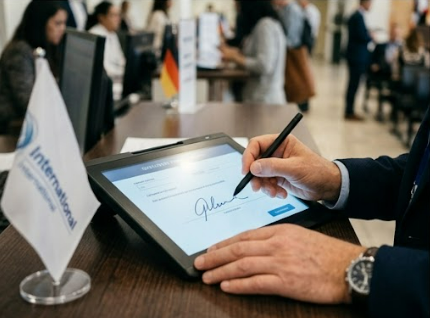
An electronic signature pad helps streamline this process by allowing documents to be displayed, reviewed and signed electronically at the service counter. Instead of printing a form and scanning it after signing, an employee can send the document directly from the government system to the signature pad. The citizen reviews the information and signs with a stylus, after which the record can proceed to the next stage.
The first major benefit is faster service. Printing and scanning may take only a few minutes for one transaction, but those minutes accumulate across thousands of applications. Electronic signing removes unnecessary handoffs between computers, printers and scanners. It can therefore shorten transaction times and help public employees serve more citizens during busy periods.
The second benefit is lower paper and administration costs. Government offices regularly process applications, consent forms, declarations, permits and acknowledgements. Paper-based handling requires paper, toner, printer maintenance, folders, filing space and document transportation. Electronic signature pads allow many of these documents to remain digital throughout their lifecycle.
The Florida Department of Transportation provides a useful overseas government example. The department requires construction contracts awarded after July 2016 to operate in a paperless environment. Stakeholders with signing responsibilities must use approved electronic or digital signatures, and documents requiring signatures must be transmitted electronically. According to the department, the policy supports paperless contract administration while distinguishing between ordinary electronic signatures and certificate-based digital signatures required for certain professional documents. Source: Florida Department of Transportation
Although this example covers construction administration rather than a public service counter, it demonstrates an important principle: eliminating paper requires both signature technology and a clearly defined digital workflow. An electronic signature pad can provide the in-person signature interface, while the supporting platform handles document transmission, authentication, approval and storage.
A third advantage is improved accuracy. Paper forms may contain illegible handwriting, missing signatures or signatures placed in the wrong location. A signature-pad system can indicate exactly where the applicant needs to sign and prevent submission when a required field is incomplete. If information needs to be corrected, employees can update the electronic form and present it again without discarding a printed document.
A fourth benefit is easier record management. Signed files can be linked to a transaction number, applicant identity, service type and timestamp. Authorized staff can retrieve records quickly, while access controls can help prevent unauthorized viewing or modification. Electronic archiving also reduces the risk of paper documents being lost, damaged or filed in the wrong location.
The UK government has published a large-scale example of the wider benefits of replacing paper-based public administration. HM Courts & Tribunals Service reported that more than 1.1 million Single Justice Procedure cases were completed digitally between April 2017 and December 2024. Before the transformation, employees manually handled large quantities of paper, repeatedly entered information and transported files between buildings. The digital system enabled faster information sharing and substantially reduced the cost of printing and transporting paper records. Source: UK Government and HM Courts & Tribunals Service
This case illustrates why signature capture should not be considered an isolated function. The greatest benefits appear when electronic signatures, digital forms, identity verification and records management are connected. A signature pad at the front counter can help ensure that a document enters the system electronically and remains electronic throughout review, approval and archiving.
Electronic signature pads can also improve accessibility and the citizen experience. The U.S. government’s Section 508 guidance notes that electronic-signature platforms can accelerate workflows, automate tracking and improve access compared with paper forms. It also emphasizes that government signature solutions should be designed so that people with disabilities can use them independently. Source: U.S. Section 508 Government Guidance

For this reason, government buyers should evaluate more than screen size and writing quality. They should also consider readable text, adjustable display settings, clear instructions, system compatibility, encryption, identity verification, audit trails and alternative signing methods for users who cannot operate a stylus.
An electronic signature pad is not simply a replacement for paper. It is an interactive terminal connecting citizens, public employees and government information systems. When deployed within a secure and legally compliant workflow, it can reduce repetitive work, lower operating costs, improve record accuracy and provide a faster, clearer and more convenient government service experience.